



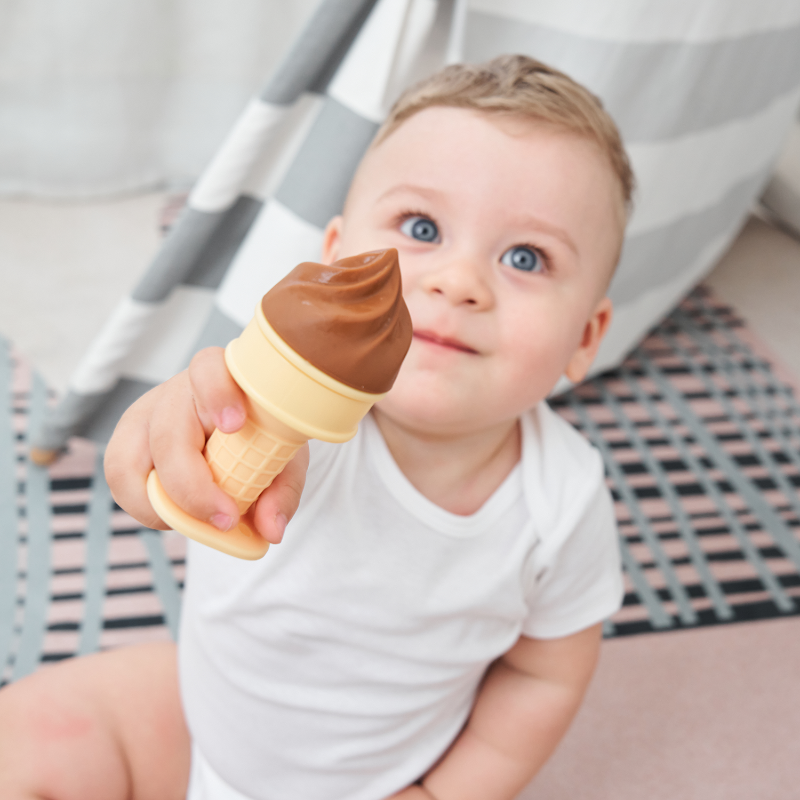
Do Newborns Need a Teether Before Teeth Even Appear? Here's Why
Do Newborns Need a Teether Before Teeth Even Appear? Here's Why
If you've ever looked at your 6-week-old baby gnawing on their fist and wondered whether they need a teether — even though their first tooth is months away — you're not overthinking it. The short answer is yes. The longer answer explains why, and it has everything to do with what your baby's mouth is doing right now, long before a single tooth appears.
🤔 Don't Teeth Need to Be Coming In for a Teether to Help?
This is the most common misconception about teethers — that they're only useful when teeth are actively breaking through gum tissue. In reality, teethers serve a completely different purpose in the 0–6 month stage that has nothing to do with tooth eruption at all.
At 0–6 months, your baby's mouth is the centre of their entire world. It's how they feed, how they explore, how they self-soothe, and how they communicate. The sucking reflex is their most powerful neurological tool — and everything they bring to their mouth is part of an active, intentional developmental process that's building the oral foundation they'll use for the rest of their lives.
A teether at this stage isn't about relieving tooth eruption pain. It's about supporting that developmental process safely — with the right shape, the right texture, and the right size for a tiny newborn mouth.
🧬 What Your Baby's Mouth Is Actually Doing Right Now
The Sucking Reflex Is Active from Birth
Babies are born with the sucking reflex fully formed — it develops in the womb from around 32 weeks. From day one, baby is already practising the rhythmic tongue wave that draws milk in, calms the nervous system, and builds the oral muscle patterns they'll rely on for months.
Mouthing Is How Newborns Learn
The mouth is a newborn's primary sensory organ — far more developed than their eyes or hands at birth. When baby brings something to their mouth, they're actively gathering information about shape, texture, temperature, and firmness. Mouthing is not random. Mouthing is learning.
Non-Nutritive Sucking Calms the Nervous System
Sucking without feeding activates the parasympathetic nervous system — heart rate slows, cortisol drops, breathing steadies. A baby who is sucking is a baby who feels safe. This is not a habit. It's biology doing exactly what it's supposed to do.
Gum Tissue Is Already Sensitive
Even without visible teeth, the gum tissue above developing tooth buds can be tender and sensitive from as early as 2–3 months. Gentle pressure on gum tissue provides comfort and stimulation that is developmentally important even before any tooth is close to breaking through.
✊ "But My Baby Just Chews Their Fist — Isn't That Enough?"
Fist chewing is completely normal at 0–6 months — it's actually a sign of healthy oral development. But there are three reasons why a purpose-designed teether is better than baby's own hand at this stage:
- 🧼 Hygiene: Baby's hands touch everything — surfaces, faces, other babies, fabrics. A dedicated teether that can be sterilised between uses is significantly cleaner than fingers that can't be.
- 📐 Shape and size: A teether designed for a 0–6 month mouth is sized and shaped to fit correctly — providing the right contact with gum tissue without forcing the jaw open too wide or creating uncomfortable pressure. Baby's whole fist is not ideally shaped for this.
- 🔒 Consistency: A wrist mitten teether stays in place through sleep, feeding, and car journeys — something baby's hand can't do. Consistent access to a safe mouthing object means the calming, developmental benefits are available whenever baby needs them.
🔍 What to Look For in a 0–6 Month Teether
Not all teethers are suitable for newborns. Here's exactly what matters at this stage:
✅ Soft Enough for Brand-New Gum Tissue
Newborn gum tissue has never been exposed to firm pressure before. Look for platinum food-grade silicone with genuine give when squeezed — not just marketed as "soft."
✅ Sized for a Small Mouth
A 0–6 month baby has a very small oral space. A teether sized for a 9-month-old will force the jaw open too wide. The teether should fit inside the mouth naturally without straining.
✅ Never-Drop Design
A 0–6 month baby has zero ability to retrieve a dropped teether. Any traditional teether that isn't attached to the baby will be on the floor within seconds. A wrist mitten design solves this completely.
✅ No Small Parts or Choking Hazards
At 0–6 months, everything goes in the mouth. Any teether with detachable parts, clips, beads, or multiple components is not appropriate for this age. One-piece seamless silicone only.
✅ Sterilisable Between Uses
Newborn immune systems are still developing. Everything that goes in the mouth needs to be dishwasher safe, boil safe, or UV steriliser compatible. No crevices or joins that harbour bacteria.
🛍️ The Right Teethers for Newborns — Before a Single Tooth Appears
Smily Mia Little Mushroom Teething Mitten — For Newborns from Birth
The mushroom cap is sized exactly for a newborn mouth — wide enough to satisfy the sucking reflex, soft enough for brand-new gum tissue, and covered in gentle nubs of varying heights that stimulate without overwhelming. The wrist mitten attachment means it stays within reach of baby's mouth at all times — day, night, in the car, during feeds. The lightest teether in the Smily Mia range, barely noticeable on a tiny wrist. Available in Pink, Purple, Blue, and Crystal.
Smily Mia Penguin Buddy Teething Mitten — Visual + Sensory from Birth
The Penguin Buddy adds a visual and sensory dimension to the newborn mouthing experience. The penguin face gives baby something to focus on — supporting early visual tracking development — while the multiple textures (smooth, ridged, raised dots) engage the sucking reflex with variety. A perfect pacifier alternative from day one. Available in 7 colors.
Frequently Asked Questions
At what age can I give my baby a teether?
From birth — provided the teether is specifically designed for newborns (soft, correctly sized, one-piece, no small parts). Wrist mitten teethers like the Smily Mia Mushroom and Penguin Buddy are rated from 0 months and used safely from birth.
My baby is 2 months old and chomping on everything — is this teething?
At 2 months, it's almost certainly not teething — teeth very rarely erupt this early. What you're seeing is the normal mouthing and sucking reflex at peak activity. Your baby is exploring with their mouth and possibly experiencing some gum sensitivity from developing tooth buds. A soft newborn teether is absolutely appropriate and helpful right now.
Is a teether better than a pacifier for a newborn?
For breastfed babies, a teether shaped like a nipple (like the Penguin Buddy or Mushroom Teether) is often preferable because it doesn't create nipple confusion — it moves with the tongue wave rather than blocking it. For bottle-fed babies, either can work, but a teether provides additional sensory stimulation and oral muscle development that a passive pacifier doesn't.
Can a teether help with the 4-month sleep regression?
The 4-month sleep regression is primarily driven by neurological development — but many babies at this stage are also beginning to experience gum sensitivity. A wrist mitten teether that stays accessible provides comfort-sucking that helps baby self-soothe during wakeful periods without being a choking hazard.
What's the difference between a 0–6 month teether and a regular teether?
Size, softness, and safety design. A 0–6 month teether is specifically sized for a newborn's smaller oral space, made from softer silicone appropriate for tender gum tissue, and designed without any small parts. See our full 0–6 Month teether collection for age-appropriate options.
The Bottom Line
Yes — newborns need teethers before teeth appear. Not because teeth are coming but because the mouth is already the centre of your baby's developmental world. The sucking reflex is active, the gum tissue is sensitive, mouthing is how they learn, and non-nutritive sucking is how they calm. A safe, correctly sized, sterilisable teether designed for 0–6 months gives baby's mouth what it's already looking for — safely, hygienically, and developmentally appropriately.
Ready to Give Your Newborn the Right Start?
Shop the Smily Mia 0–6 Month teether collection — designed from birth, around your baby's biology.
Shop 0–6 Month Teethers →
Dejar un comentario