



When Do Babies Start Teething? Signs, Stages & What Actually Helps
Baby Development · Teething Guide
When Do Babies Start Teething? Signs, Stages & What Actually Helps
Your baby is drooling nonstop, chewing on their fists, and waking up more than usual. You already know what's coming — but when exactly does teething start, what should you expect, and what actually works to help? This complete guide has everything you need.
Teething is one of the most talked-about milestones in early parenting, and for good reason. It's one of the first experiences where your baby is in genuine discomfort and can't tell you what's wrong. Understanding the teething process — the timeline, the symptoms, and the right tools for each stage — makes a real difference for both you and your little one.
When Do Babies Start Teething? The Real Timeline
Most babies begin teething somewhere between 3 and 7 months, with the average being around 6 months. But there's a wide range — some babies get their first tooth at 4 months, others not until 12 or 13 months. Both are completely normal.
What matters more than the exact month is recognizing the signs when they appear and having the right tools ready. Here's a general teething timeline by age:
Months
Pre-Teething Phase
No teeth yet, but your baby is already developing the oral reflex — sucking fists, mouthing objects, and exploring with their gums. This is the time to introduce a wearable teething mitten, which satisfies the natural urge to suck and chew without any drop risk.
→ Smily Mia Penguin Buddy Teething Mitten (0–6 months)Months
Early Teething Signs Begin
Drooling increases dramatically. You'll notice fussiness, red and swollen gum patches, and your baby chewing on anything within reach. The lower central incisors (bottom front teeth) are usually first. This is when teething pain starts and a good silicone teether becomes essential.
→ Smily Mia Norman Dinosaur Teether (3 months+)Months
First Teeth Emerge
The bottom front teeth typically break through first, followed by the upper central incisors. Your baby can now grip objects better, so teethers with easy-hold shapes become important. Cooling teethers — especially water-filled and freezable ones — provide targeted gum relief at this stage.
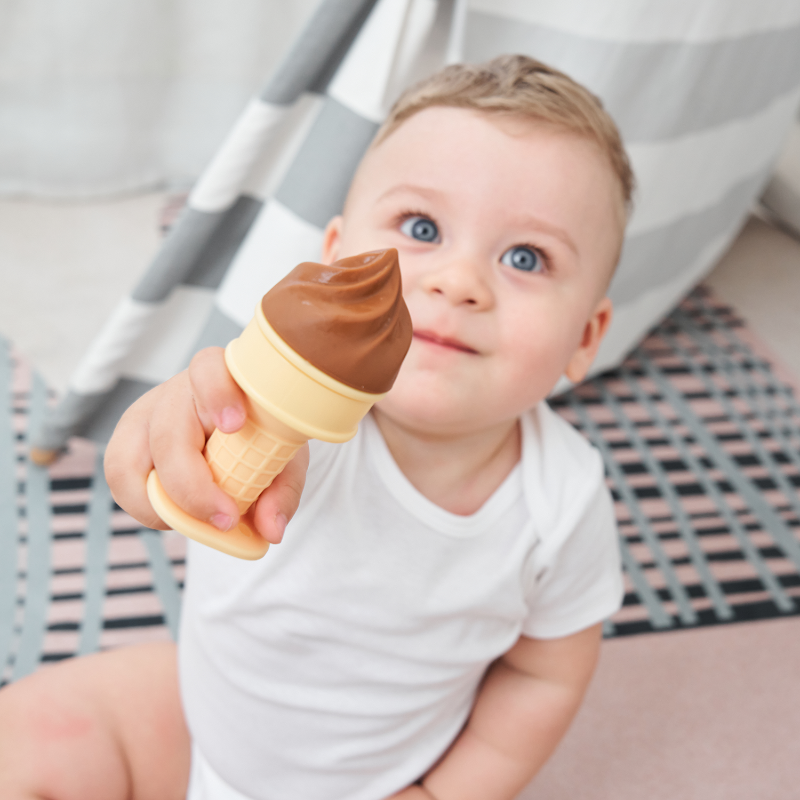
→ Smily Mia Ice Cream Cooling Teether (4 months+)Months
Lateral Incisors & More
The side front teeth (lateral incisors) come in, and your baby is becoming more mobile and independent. Multi-textured teethers with varied surfaces help reach different parts of the gum. Bath-time teethers are also a great choice since water naturally soothes inflammation.
→ Smily Mia Nora Narwhal Bath-Time Teether (4 months+)Months
Molars & Canines
First molars arrive around 12–16 months, followed by canines and second molars. This is often the most uncomfortable phase because molars are larger and apply more pressure as they push through. Firmer, multi-textured teethers that babies can grip and angle themselves are best here.
→ Smily Mia Flip Flop Teether (6 months+)By age 3, most children have all 20 primary (baby) teeth. The teething process isn't a one-time event — it's a two-year journey, so having the right tools for each phase is worth the investment.
How to Tell If Your Baby Is Teething: 8 Common Signs
Teething symptoms vary baby to baby. Some sail through it with barely a fuss; others are clearly uncomfortable for days before a tooth appears. Here are the most common signs to look out for:
Teething does not cause high fever, diarrhea, or severe vomiting. If your baby has a fever above 38°C (100.4°F) or seems seriously unwell, consult your doctor — these symptoms point to an illness, not teething.
How to Soothe a Teething Baby: What Actually Works
There's a lot of noise around teething remedies — and unfortunately, a lot of products that don't work, or worse, aren't safe. Here's what genuinely helps, backed by pediatric guidance:
-
1Use a BPA-Free Silicone Teether
The most effective and safest option. Food-grade silicone teethers apply counter-pressure directly to the gum, which is the primary mechanism for pain relief. Look for FDA-certified, BPA-free products — like those from Smily Mia's teether collection — which meet strict safety standards and have no toxic softeners. -
2Try a Cooling or Freezable Teether
Cold naturally numbs inflamed gum tissue. Chill (not freeze solid) a water-filled teether in the refrigerator for 15–20 minutes before giving it to your baby. The Smily Mia Ice Cream Cooling Teether has thermal protection built in — it stays cool longer without becoming dangerously hard. -
3Use a Wearable Teething Mitten for Young Babies
Babies under 6 months can't reliably hold a teether — they'll drop it and cry. A teething mitten attaches to their wrist so it stays put no matter what. It also redirects thumb-sucking and finger-chewing habits naturally. The Smily Mia Little Mushroom Teething Mitten is ultra-light and designed for newborns up to 6 months. -
4Gum Massage with a Clean Finger
Gently rubbing the gum with a clean finger for a minute or two provides immediate pressure relief. It won't replace a teether but works well as an emergency measure when nothing else is to hand. -
5Distraction & Extra Comfort
Sometimes the most effective "remedy" is extra skin contact, a change of scenery, or a walk outside. Teething pain feels worse when a baby is bored or overtired, so anything that shifts their attention helps. -
6Infant Pain Relief (Consult Your Doctor First)
In cases of severe discomfort, your pediatrician may recommend age-appropriate infant acetaminophen (paracetamol) or ibuprofen (for babies 6 months+). Always follow dosage guidelines and use as a last resort alongside physical teethers, not instead of them.
Avoid teething gels containing benzocaine (linked to a rare blood condition in infants), amber teething necklaces (serious choking and strangulation risk), and any hard plastic teethers that contain BPA or phthalates. Always choose food-grade silicone with FDA certification.
⭐ Smily Mia Pick for 0–6 Months
Penguin Buddy Teething Mitten — Never-Drop Wrist Teether
Designed for newborns through 6 months, the Penguin Buddy stays on your baby's wrist so there's no dropping, no reaching, and no crying because the teether fell on the floor. Made from food-grade, BPA-free silicone with multiple chew textures to stimulate gum relief. Pediatrician-friendly design also prevents finger and thumb sucking habits from forming.
Shop Penguin Buddy View All TeethersChoosing the Right Teether for Your Baby's Age
Not all teethers are built for every age. Using the wrong one — too hard, wrong shape, or wrong size — can actually make things worse. Here's a quick breakdown of what to look for by age group:
0–3 Months: Teething Mittens
At this stage your baby has zero grip strength. A wearable silicone mitten is the only sensible option — it attaches to the wrist and stays within reach of the mouth naturally. Look for ultra-light designs with soft nubs on the surface that provide gentle gum stimulation without being too firm for newborn gums.
3–6 Months: Animal-Shaped Teethers
Grip is developing but still limited. Choose teethers with easy-grab shapes — wide bodies, looped handles, or animal forms that are naturally easy for small fists to hold. The Norman Dinosaur Teether has a chunky, easy-grip body with textured spikes that babies at this age find instinctively satisfying to chew.
4–8 Months: Cooling & Water-Filled Teethers
As the first teeth actually break through the gum surface, inflammation peaks. This is when cooling teethers make the biggest difference. The Ice Cream Cooling Teether can be chilled in the fridge and has a thermal protection layer so your baby doesn't get direct ice contact — just sustained, safe coolness.
6–12 Months: Multi-Texture & Bath Teethers
By now your baby has better grip and loves exploring different textures. Look for teethers that offer varied surfaces — ridged, smooth, knobbled — so they can find the exact pressure point that feels best on their gums. Bath-time teethers like the Nora Narwhal double up as sensory play toys and are easy to keep clean.
Why Food-Grade Silicone Is the Safest Choice for Baby Teethers
Not all teethers are made equal. The material your baby is chewing on for hours every day matters enormously. Here's why food-grade silicone is the gold standard:
-
✓No BPA, no phthalates, no toxic softeners — silicone is chemically inert and doesn't leach harmful substances when chewed.
-
✓Soft and flexible — gentle on sensitive newborn gums, unlike hard plastic or rubber which can bruise delicate tissue.
-
✓Easy to clean — most food-grade silicone teethers are dishwasher-safe and can be sterilized by boiling for 5 minutes.
-
✓Durable — silicone holds its shape and doesn't crack, chip, or degrade the way some cheaper materials do.
-
✓FDA-certified options — brands like Smily Mia produce teethers that meet FDA certification standards, giving parents a clear safety benchmark to look for.
Every teether in the Smily Mia teether collection is made from food-grade, BPA-free silicone and meets FDA certification standards. They're also free from latex, phthalates, and PVC — so you're not guessing about what's in your baby's mouth.
⭐ Smily Mia Pick for Active Teethers (3–12 Months)
Reindeer Teether Mitten — Gum Massager & Pain Relief
For babies 3–12 months who are in the thick of teething, the Reindeer Teether Mitten provides sustained gum relief with a wearable, never-drop design. Multiple chew textures — ridged, smooth, and nubbed — let your baby find their preferred pressure point naturally. BPA-free silicone, pediatric dentist-approved, and available in 6 colors.
Shop Reindeer Teether View All TeethersFrequently Asked Questions About Baby Teething
Is it normal for a baby to start teething at 3 months?
Yes — while the average age for a first tooth is around 6 months, some babies start as early as 3 months. You may notice signs like drooling and chewing well before any tooth appears. Starting with a teething mitten at this stage is completely appropriate and helpful.
Can teething cause a fever?
Teething can cause a very slight rise in body temperature, but not a true fever. If your baby's temperature exceeds 38°C (100.4°F), it's caused by something else — likely an infection. Always consult your pediatrician if your baby has a genuine fever.
How long does teething pain last?
The most intense discomfort usually lasts 3–5 days around the time each tooth erupts — a day or two before and a day or two after it breaks through the gum. The teething process as a whole spans from around 6 months to 2–3 years as all 20 primary teeth come in.
Are silicone teethers better than rubber ones?
Food-grade silicone is generally preferred over natural rubber because it's latex-free (important for allergy risk), more durable, and easier to sterilize. Natural rubber can degrade over time and harbor bacteria if cracked. Look for teethers labelled food-grade silicone with FDA certification for the highest safety standard.
When should I worry about delayed teething?
If your baby has no teeth by 18 months, mention it to your pediatrician or pediatric dentist. In most cases late teething is just genetic variation, but occasionally it can signal a nutritional deficiency or developmental factor worth reviewing.
The Bottom Line
Teething is unavoidable, but it doesn't have to be miserable. Understanding when babies start teething, what the signs look like at each stage, and having the right tools ready makes a genuine difference — for your baby's comfort and your own peace of mind.
The key takeaways: teething typically starts between 3–7 months, peaks in discomfort as each tooth breaks through, and continues all the way to age 3. The safest and most effective tool at every stage is a food-grade, BPA-free silicone teether matched to your baby's age and grip ability.
At Smily Mia, every teether is designed with a specific stage in mind — from wearable mittens for newborns to multi-texture chew toys for active teethers. All are made from FDA-certified, food-grade silicone with no compromises on safety.
Ready to Make Teething Easier?
Browse Smily Mia's full range of BPA-free, food-grade silicone teethers — designed for every stage from 0 to 12 months.
Shop All Teethers →
Laissez un commentaire